
Portfolio Companies Need an Operating Strategy That Is as Strong as Their Growth Strategy

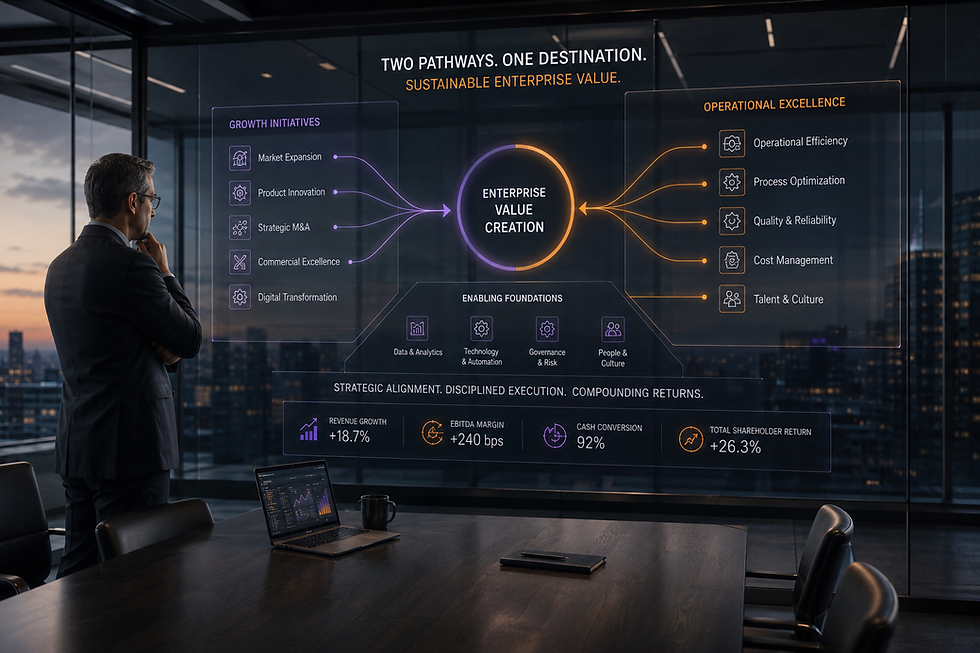
Why Sustainable Enterprise Value Requires More Than Revenue Expansion
Growth has always been a central objective of private equity investing. Investors seek opportunities to expand market share, increase revenue, enter new markets, launch new products, and strengthen competitive positioning. Management teams are often incentivized around growth objectives, and strategic plans frequently focus on customer acquisition, commercial execution, and top-line performance. Revenue growth remains one of the most visible indicators of business momentum and an important component of enterprise value creation.
However, growth alone does not guarantee value creation.
Many organizations successfully increase revenue while simultaneously creating operational challenges that limit profitability, constrain scalability, and reduce long-term performance. As companies grow, complexity often grows alongside them. New customers create new demands. New markets introduce new requirements. Additional products increase operational dependencies. Teams expand, reporting structures evolve, and technology environments become more fragmented.
When these changes occur without a corresponding evolution of the operating model, organizations frequently find themselves growing faster than they can effectively execute.
This reality is becoming increasingly important in today's private equity environment. As investors place greater emphasis on operational performance, margin expansion, and sustainable EBITDA growth, the strength of a company's operating strategy has become just as important as the strength of its growth strategy. Organizations that successfully align the two are often able to create meaningful enterprise value. Organizations that prioritize growth without operational readiness frequently encounter challenges that limit their ability to realize the full benefits of expansion.
Growth Strategies Often Receive More Attention Than Operating Strategies
One of the most common observations across growing organizations is the imbalance between strategic planning and operational planning.
Most companies can clearly articulate their growth strategy. Leadership teams understand their target markets, customer segments, competitive positioning, pricing models, and revenue objectives. They maintain detailed forecasts, sales plans, marketing initiatives, and expansion roadmaps. Significant time and resources are invested in determining how the organization will grow over the next three to five years.
Far less attention is often dedicated to how the organization will operate once that growth occurs.
Questions surrounding process scalability, organizational design, technology alignment, decision-making structures, and execution capacity frequently receive less scrutiny. The assumption is often that operational challenges can be addressed as they emerge. Unfortunately, this reactive approach can create significant inefficiencies over time.
As growth accelerates, operational weaknesses become increasingly difficult to manage. Processes that functioned effectively at a smaller scale begin to break down.
Technology platforms that once met business requirements become constraints. Organizational structures designed for a different stage of growth create bottlenecks that slow execution.
The result is a disconnect between strategic ambition and operational capability.
Organizations may know where they want to go, but they lack the infrastructure necessary to get there efficiently.
Operational Capacity Determines How Much Growth an Organization Can Absorb
Every organization possesses a finite capacity for growth.
This capacity is not determined solely by market demand or sales effectiveness. It is heavily influenced by operational readiness. The ability to onboard customers, fulfill commitments, manage resources, support employees, maintain quality, and execute consistently all contribute to an organization's ability to absorb growth successfully.
Companies often underestimate this reality because operational constraints are less visible than commercial opportunities. Revenue opportunities are easy to quantify. Operational limitations are often hidden until growth begins placing stress on the system.
Customer service response times increase. Project delivery schedules slip. Reporting accuracy declines. Employee workloads become unsustainable. Management teams spend more time resolving operational issues than pursuing strategic initiatives.
These challenges are frequently interpreted as symptoms of growth. In reality, they are often symptoms of insufficient operating capacity.
The distinction is important because growth itself is not the problem. The problem is an operating model that has not evolved at the same pace as the business.
Organizations that create sustainable value recognize that growth capacity must be intentionally developed. They continuously evaluate how processes, systems, organizational structures, and workflows will support future expansion. Rather than waiting for operational problems to emerge, they proactively strengthen the foundation required to support growth.
Operating Strategy Is Ultimately About Execution
At its core, an operating strategy answers a simple question:
How will the organization consistently execute its business objectives?
While growth strategies define what the organization intends to achieve, operating strategies define how those objectives will be delivered.
An effective operating strategy addresses several critical areas. It defines how work flows across the organization. It establishes accountability structures and decision-making frameworks. It aligns technology investments with business priorities. It ensures resources are allocated efficiently and that operational processes support strategic objectives.
Without these elements, organizations often rely on individual effort rather than organizational capability.
High-performing employees compensate for inefficient processes. Managers intervene to resolve recurring issues. Teams create workarounds to address system limitations. While these approaches may sustain performance temporarily, they become increasingly difficult to maintain as the business scales.
Eventually, execution becomes dependent on heroics rather than systems.
Organizations that invest in operating strategy create repeatability. They reduce dependency on individual effort and establish structures that support consistent performance across the business. This not only improves efficiency but also increases resilience, scalability, and enterprise value.
Technology Investments Cannot Replace Operating Strategy
Many organizations attempt to solve operational challenges through technology investments.
New platforms are implemented to improve visibility. Automation tools are introduced to increase efficiency. Analytics solutions are deployed to improve decision-making. While these investments can be valuable, they often fail to deliver expected returns when operating strategy is absent.
Technology is most effective when it supports a well-defined operating model.
Organizations with unclear processes frequently automate inefficiencies. Companies with fragmented governance structures often struggle to generate meaningful insights from new analytics platforms. Businesses lacking operational discipline may invest heavily in technology while achieving limited improvements in performance.
Technology should enable execution. It should not define execution.
This distinction has become increasingly important as organizations invest in artificial intelligence, automation, and digital transformation initiatives. The companies generating the strongest returns from these investments are typically those that first establish operational clarity. They understand how work should be performed before determining how technology can enhance it.
As a result, their technology investments strengthen an already effective operating model rather than attempting to compensate for a weak one.
The Strongest Companies Align Growth and Operations
Organizations that consistently create enterprise value understand that growth and operations are not separate priorities. They are interconnected components of the same strategy.
Growth creates opportunity. Operations determine whether that opportunity can be realized efficiently.
When growth and operations remain aligned, organizations can scale without creating excessive complexity. Revenue increases are supported by efficient processes. Customer acquisition is supported by effective delivery capabilities. Strategic initiatives are reinforced by operational discipline.
This alignment allows businesses to generate stronger margins, improve customer experiences, accelerate execution, and create sustainable competitive advantages.
Most importantly, it allows organizations to convert growth into enterprise value.
The strongest portfolio companies are rarely the ones pursuing growth at any cost. They are often the organizations that expand thoughtfully while continuously strengthening the operating foundations that support future success.
Sustainable Enterprise Value Requires Both
Private equity firms have always focused on growth as a driver of value creation. That focus will remain important. Revenue expansion, market share gains, and commercial performance will continue to influence investment outcomes.
However, the ability to sustain that growth is increasingly determined by operational effectiveness.
Organizations that treat operating strategy as an afterthought often discover that growth creates complexity faster than value. Processes become strained, costs increase, execution slows, and organizational agility declines. The very growth that was intended to create value begins to erode it.
Organizations that invest in operating strategy create a different outcome. They build scalable processes, align technology with business objectives, strengthen organizational effectiveness, and establish the execution capabilities required to support long-term growth.
For investors, operators, and executive leadership teams, the implication is clear. Growth strategy remains essential, but it is no longer sufficient on its own.
The organizations most likely to create sustainable enterprise value are those that recognize that growth and operations must evolve together. One creates opportunity. The other determines how much value can ultimately be captured.


Comments