
The Next Decade of PE Returns Will Be Operational, Not Financial


For much of the past two decades, private equity returns were strongly influenced by financial engineering. Entry multiple expansion, inexpensive leverage, and favorable exit environments created tailwinds that amplified investment performance. In many situations, operational improvement inside portfolio companies was important, but not always the decisive factor in determining investment outcomes.
That environment is changing.
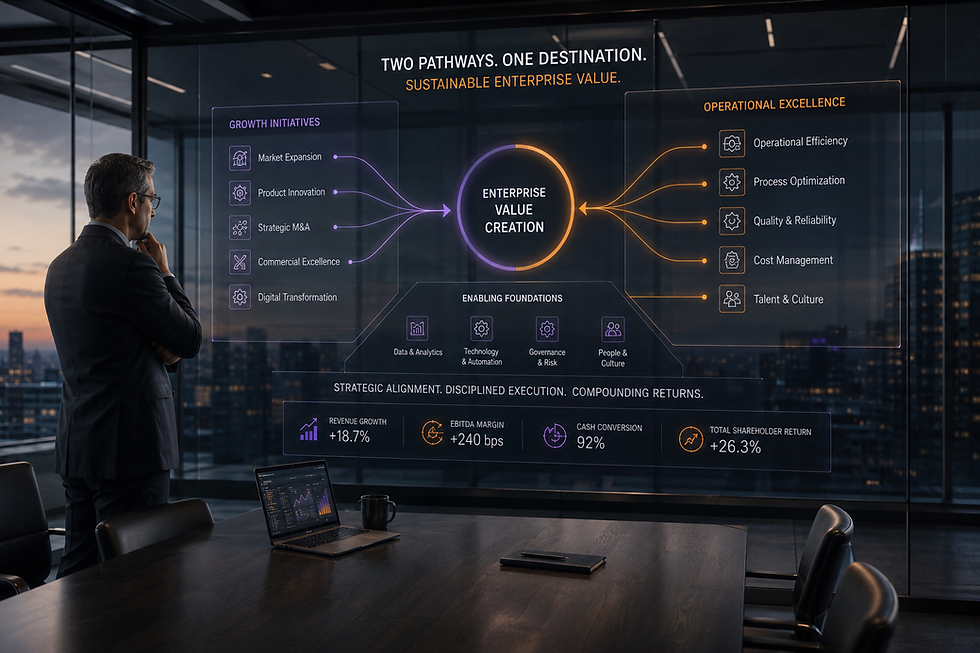
Across lower and middle market private equity, operating partners and portfolio company leadership teams are now facing a more demanding performance landscape. Entry valuations remain elevated relative to historical norms, financing conditions are less predictable, and holding periods are extending. These dynamics are gradually shifting the center of gravity in value creation from capital structure optimization toward operational execution.
In practical terms, this means that the next decade of private equity returns will be driven less by financial leverage and more by what happens inside the operating model of the business.
The Limits of Financial Tailwinds
The traditional drivers of private equity performance are becoming less reliable as standalone levers.
Higher purchase multiples increase the margin for error at entry. Longer hold periods place greater emphasis on sustained performance rather than short-term valuation expansion. More selective exit conditions require portfolio companies to demonstrate real earnings quality and operational resilience rather than relying on market momentum.
These factors do not eliminate the importance of disciplined dealmaking. However, they do reduce the degree to which financial structuring alone can compensate for operational underperformance.
As a result, sponsors are increasingly underwriting operational value creation as a core component of investment theses rather than treating it as an enhancement opportunity after acquisition.
Operational Engineering as a Discipline
This shift is elevating the importance of what might be described as operational engineering.
Operational engineering goes beyond traditional cost reduction initiatives or isolated transformation programs. It involves deliberate redesign of the operating model to improve how work is structured, how decisions are made, and how performance is managed across the organization.
In many portfolio companies, the primary constraints to value creation are not strategic direction or market opportunity. They are execution capacity, structural complexity, and misalignment between growth ambitions and operating discipline.
Common patterns emerge across sectors. Organizations scale revenue faster than they scale operational processes. Functional silos develop as teams grow. Technology tools accumulate without corresponding workflow clarity. Leadership attention is absorbed by day-to-day delivery rather than structural improvement.
Over time, these conditions create friction that limits margin expansion and slows the realization of investment theses.
Operational engineering addresses these constraints by focusing on structural efficiency. This may include redesigning delivery models, rationalizing vendor ecosystems, improving throughput across critical processes, and aligning organizational accountability with performance priorities.
The objective is not simply to reduce cost. It is to improve the unit economics and execution consistency of the business in a way that supports both growth and profitability.
Execution Capacity as the New Constraint
One of the most significant but underappreciated challenges in portfolio company value creation is execution capacity.
Sponsors frequently identify multiple levers for performance improvement during diligence. These may include procurement savings, pricing optimization, workforce productivity, systems integration, or digital enablement. However, after acquisition, management teams often find themselves constrained by limited bandwidth to execute these initiatives alongside ongoing operational responsibilities.
This creates a gap between value creation ambition and implementation reality.
In environments where timelines are compressed and investor expectations remain high, the ability to mobilize focused execution resources can become a decisive advantage. Portfolio companies that establish clear operating priorities and deploy structured execution approaches earlier in the ownership cycle are often better positioned to deliver consistent performance improvements over time.
Conversely, organizations that delay operational redesign may find that complexity compounds as they grow, making later-stage transformation more disruptive and less effective.
Leadership Alignment and Operating Discipline
Another defining feature of the emerging value creation environment is the heightened importance of leadership alignment around operational priorities.
Portfolio company executives are increasingly expected to balance multiple imperatives simultaneously. They must deliver near-term financial performance, support strategic growth initiatives, and prepare the organization for eventual exit. Achieving these outcomes requires not only strategic clarity but also disciplined execution across functional areas.
High-performing portfolio companies tend to share several characteristics. Leadership teams align early on the operational implications of the investment thesis. Performance metrics are translated into specific execution initiatives. Accountability for improvement efforts is clearly defined. Operational reviews focus not only on financial results but also on progress against structural efficiency goals.
These practices reinforce a culture where operational improvement is treated as a continuous management discipline rather than a one-time project.
A More Operational Future for Private Equity
As private equity continues to mature, the distinction between financial engineering and operational engineering is becoming more pronounced. Sponsors that build institutional capability in operational value creation are likely to be better equipped to navigate environments characterized by higher valuations, longer hold periods, and more complex exit pathways.
For portfolio company CEOs and operating partners, this shift represents both a challenge and an opportunity. The challenge lies in adapting leadership approaches and operating models to meet more demanding performance expectations. The opportunity lies in creating durable improvements in how businesses generate earnings and sustain growth.
In this context, the ability to translate value creation priorities into disciplined operational execution is increasingly central to investment success.
Fractional Talent works alongside sponsors and portfolio company leadership teams to support this transition. By focusing on operating model clarity, cost structure optimization, and execution capacity, the firm helps organizations advance value creation initiatives in ways that strengthen both performance outcomes and exit readiness.


Comments